
About Escalera
Rooted in equity, creativity, and authentic connection, Escalera Academy, LLC is an innovative education initiative committed to cultivating a village of support where students, educators, and education advocates can access guidance, resources, and high-quality programming.
The name Escalera—meaning “ladder” or “stairway” in Spanish—represents growth, support, and upward progress. At Escalera Academy, we believe learning should be a step-by-step pathway, empowering youth to explore, create, and contribute to their communities.
-
About KES (Kinesiology, Engineering, Sustainability)
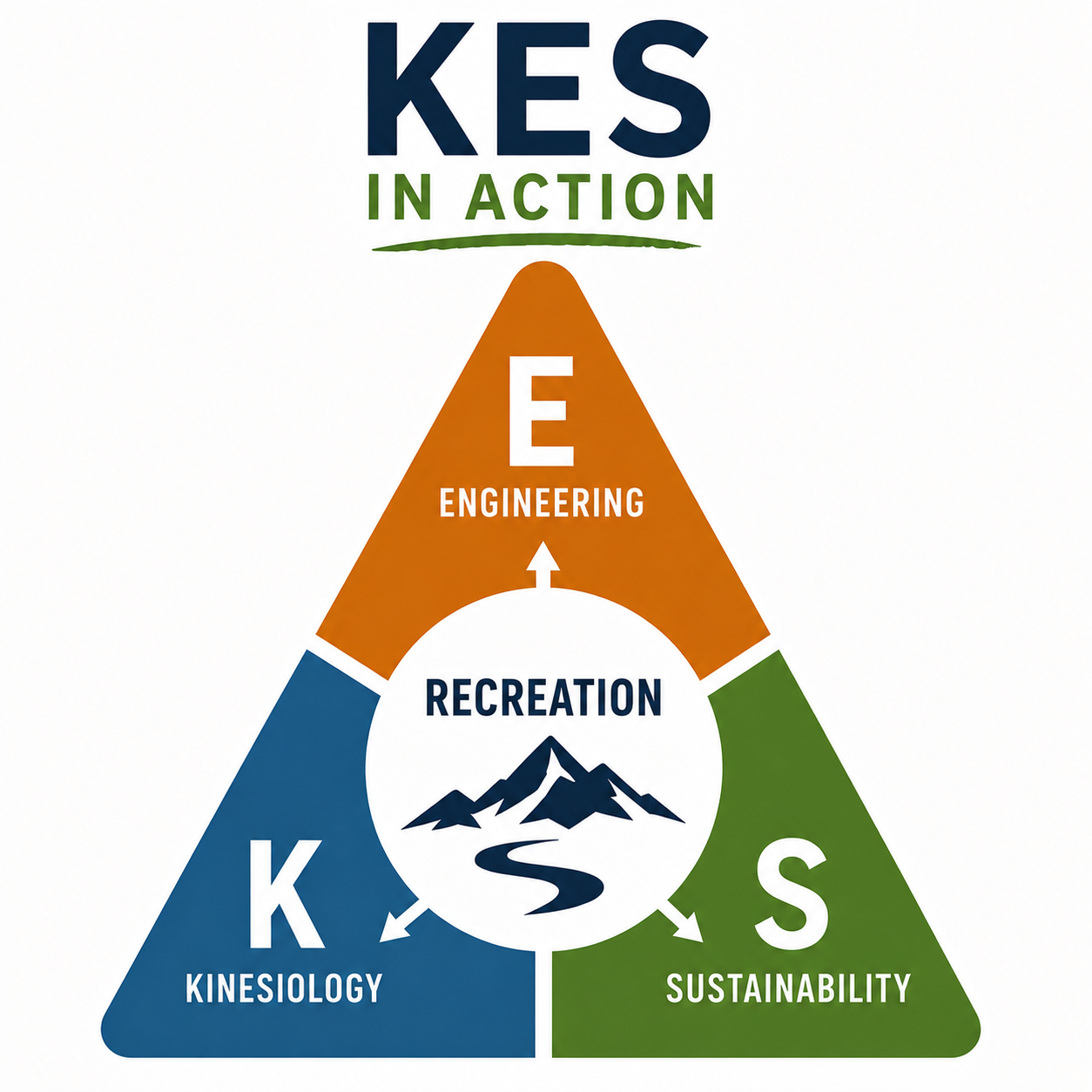
KES is a systems-based STEAM outdoor education framework that uses recreation and outdoor environments as the applied context for learning. It connects classroom concepts to real-world experiences where students actively engage with science, human movement, and environmental systems through structured, hands-on instruction.
At its core, KES integrates three interconnected lenses:
Kinesiology — human movement, biomechanics, performance, and injury prevention in real-world activity
Engineering — the design, function, and mechanics of outdoor gear and recreation systems
Sustainability — environmental impact, resource use, and long-term stewardship of natural spaces
Rather than teaching these areas as separate subjects, KES brings them together as one unified system. Students learn to understand how movement, equipment, and environment continuously interact in outdoor settings such as climbing, hiking, navigation, and exploration.
KES blends classroom learning with field-based application, integrating disciplines such as biology, geology, environmental science, and physical education. Each learning experience is anchored in a real-world activity, allowing students to apply concepts in motion, in context, and in real time.
The result is a learning model where students do not simply study systems—they experience and analyze them as they occur.
Every program is built around a featured outdoor activity such as climbing, rafting, skiing, etc. These experiences serve as living classrooms where students connect academic concepts to real-world systems.
Our programs are designed to be interdisciplinary, experiential, and applied.
Our Approach
KES is built on the belief that meaningful learning happens when students can see, do, and understand simultaneously. By combining structured instruction with real-world application, KES creates learning environments where knowledge is active, embodied, and transferable.
This approach prepares students to think critically, move intentionally, and understand how human, engineered, and environmental systems work together in the world around them.
-
Most outdoor education programs teach the activity.
Students focus on how to climb a rock wall, paddle a kayak, ride a bike trail, or spend a night camping. They develop skills, build confidence, and gain valuable outdoor experiences.
Those experiences matter.
But at Escalera Academy, we believe there is another question worth asking:
What makes recreation possible?
A climbing route does not exist because someone simply decided to climb there. It exists because of geology, land management decisions, engineering, access agreements, equipment design, and generations of people who shaped how that place is used.
A ski area depends on mountain ecosystems, water resources, snowpack, infrastructure, transportation systems, and a workforce that keeps operations running.
A river trip depends on watersheds, reservoirs, wildlife management, public policy, Indigenous knowledge, recreation businesses, and environmental stewardship.
Recreation does not happen in isolation. It is the result of interconnected environmental, cultural, economic, and engineering systems.
That is the foundation of the KES Framework.
Through Kinesiology, Engineering, and Sustainability, students explore not only how recreation works, but why it works.
They examine how gear is designed, how the body moves, how landscapes function, how communities interact with natural resources, and how decisions affect the future of outdoor spaces.
Students investigate questions such as:
How do trails impact wildlife habitat?
Where do outdoor products come from?
What role does Indigenous knowledge play in land stewardship?
How do recreation economies support communities?
What are the tradeoffs between access, preservation, and conservation?
How does climate influence the places where we recreate?
By exploring these questions, students develop systems-thinking skills that extend far beyond recreation itself.
At Escalera Academy, recreation is not the destination.
It is the lens.
We use recreation as a gateway to help students understand the environmental systems, engineering innovations, cultural perspectives, and human decisions that shape the world around them.
Because we don't just teach recreation.
We teach what makes recreation possible.
-
This structure ensures students engage with all five Escalera Academy learning environments:
Gear Investigation Units
Gear Design Units
Field Investigation Units
Human Performance Units
Traditional STEM Unit
The Heart of Escalera
We believe that education is most powerful when it uplifts the whole community. By creating supportive networks among students, families, schools, and local organizations, Escalera Academy builds pathways toward sustainable, meaningful futures, where everyone can climb their own stairway to success.
We’re starting small, but thinking big, with a focus on local impact and building sustainable partnerships with schools, families, and community members.